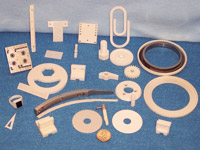
Advanced Technical Ceramic Manufacturing
Plus Precision Machining of Polyurethane and Plastics
RocCera Advanced Technical Ceramics
RocCera has the in-house expertise to cost-effectively manufacture many oxide based advanced technical ceramics. Many proprietary and patented ceramic technologies give RocCera a competitive edge. RocCera has a successful track record of applying advanced ceramic technologies by replacing steel and cemented carbides to significantly improve productivity and process reliability.
The RocCera advanced ceramics team is always at the forefront of innovations – continually improving the process and the product reliability. RocCera will undertake any challenge, small or large, and work collaboratively with the customer to develop, design and manufacture the desired ceramic components.
RocCera Advanced Ceramics
| Ceramic | Composition | Properties |
| RTZ – RocCera Tetragonal Zirconia | Zirconia + 3 mole% yttria | |
| RATZ – RocCera Alumina Toughened Zirconia | 85% zirconia + 15% alumina | |
| RZTA – RocCera zirconia toughened alumina | 80% alumina + 20% zirconia | |
| HP Alumina – High Purity | 99.9% pure alumina | |
| 96 Alumina – Thermally stable alumina | 96% pure alumina | |
| Alumatough | 99.9% alumina blended with SiC whiskers |
RocCera Tetragonal Zirconia (RTZ), also known as ceramic steel, is tougher than any other advanced technical ceramic available today. Imagine ceramic parts with the toughness of steel, but with greater surface hardness, higher abrasion and corrosion resistance.
Low cost has not been an attribute readily associated with ceramics which are hard to machine. “Net-shape” manufacturing technology circumvented that problem by eliminating or drastically reducing the machining cost. These technologies enabled RTZ ceramics to compete head-on with steel and other structural materials. All these factors contribute to a longer life, higher reliability and greater profitability.